
2026-09-24
QDay's Aevum Testnet: An EVM-Compatible Network for Agentic Commerce
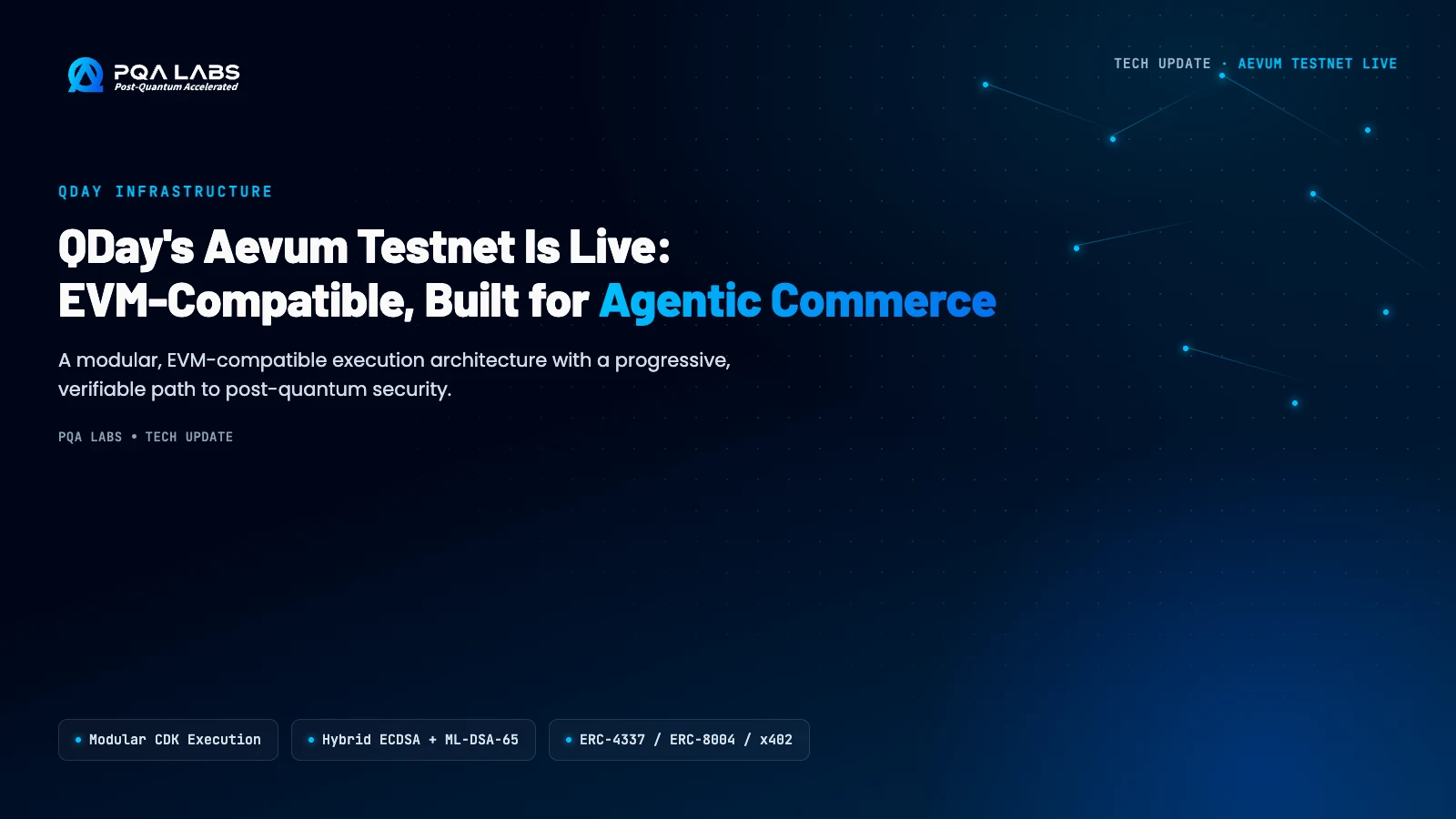
QDay Network has moved a core piece of its infrastructure forward: Aevum Testnet, a modular re-architecture of QDay's EVM-compatible stack, is now publicly live. For developers, ecosystem partners, and anyone tracking how post-quantum cryptography moves from research into production infrastructure, the interesting part is what changed underneath: the execution architecture, and the concreteness of the cryptographic roadmap built on top of it.
This piece walks through what Aevum actually is, what has changed architecturally, and why the launch matters beyond a routine version bump.
What Is the Aevum Testnet?
Aevum is the next iteration of QDay's execution layer: a general-purpose, EVM-compatible network built around a modular, CDK-based execution design. It is best understood as an architectural upgrade to the existing QDay network, extending the same underlying thesis QDay set out to build — an EVM-compatible chain for payments and automation, with a real path to post-quantum security. What has changed is the execution architecture underneath it, and the concreteness of the cryptographic roadmap sitting on top of it.
Because Aevum is EVM-compatible, developers and users can connect with existing tooling — MetaMask and other standard EVM wallets work without a dedicated app, which lowers the barrier to testing the network compared with chains that require proprietary wallet software.
Why a Modular Architecture, Not an Incremental Patch
Blockchain execution stacks generally face a tradeoff between patching an existing implementation in place and rebuilding around a cleaner, more modular foundation. QDay's team opted for the latter with Aevum: a modular, CDK-based execution layer rather than a series of incremental upgrades to the prior stack.
The practical benefit of a modular design is flexibility further down the line — new proving systems, new signature schemes, and new execution modules can be swapped in without re-architecting the chain from scratch each time. That flexibility matters directly for the post-quantum roadmap described below, which depends on being able to introduce new cryptographic primitives without disrupting the network in production.
A Progressive Path to Post-Quantum Security
Post-quantum security is a roadmap QDay is executing in stages. That staged framing is itself the more credible way to make the claim: Aevum introduces a progressive PQC migration path with three transaction-security modes:
- Classical (ECDSA) — the signature scheme used across most of today's EVM ecosystem, for compatibility with existing tooling.
- Hybrid (ECDSA + ML-DSA-65) — classical and post-quantum signatures used together, giving quantum resistance without discarding compatibility with the existing EVM security model.
- Native post-quantum — full migration to post-quantum signature schemes as the ecosystem and tooling mature.
The hybrid mode's use of ML-DSA-65 (a NIST-standardized lattice-based signature algorithm, part of the CRYSTALS-Dilithium family) reflects a broader industry pattern: teams building for post-quantum security today are choosing algorithms with mature, audited open-source library support, rather than schemes that are theoretically faster but lack production-ready tooling. Framed honestly, this is still an open engineering problem across the industry — post-quantum signature verification is measurably more computationally expensive than classical ECDSA. That is exactly why a modular execution layer and a staged migration path are the more defensible way to approach it, compared with committing to a single full-cutover launch date.
Built for Agentic Commerce
QDay's stated audience — payment processors, merchants (including agentic commerce use cases), and developers building DeFi applications and one-person/agent-operated companies — shows up directly in Aevum's design choices:
- ERC-4337 account abstraction brings smart-contract wallets to the network, enabling programmable transaction logic — spending limits, session keys, batched operations — on top of standard accounts.
- ERC-8004 agent identity gives autonomous agents a verifiable on-chain identity distinct from the human or organization operating them — a prerequisite for any serious agent-to-agent or agent-to-merchant payment flow.
- x402 support brings a standardized micropayment protocol for machine-initiated payments, relevant as more transactions on the network are expected to originate directly from software agents.
Together, these give the network concrete building blocks for autonomous agents to transact on it directly, going beyond a general "AI-ready" label. QDay has also been explicit about its intended role: connective infrastructure that lets external developers plug into existing high-liquidity DeFi protocols through QDay, positioning the network as a layer other applications build on top of.
What This Means for Developers, Investors, and Ecosystem Partners
For developers, Aevum's EVM compatibility and standard tooling support mean the entry cost to build and test on QDay is low — existing Solidity contracts, existing wallets, and existing developer workflows carry over directly.
For investors and ecosystem partners evaluating post-quantum infrastructure, the relevant signal is a technical roadmap in production: a hybrid classical/post-quantum signature scheme live on a public testnet, built on a modular execution layer designed to accommodate further cryptographic upgrades. That is a materially more concrete milestone than a whitepaper-stage roadmap item, and it is worth tracking as the space moves from post-quantum research toward post-quantum production systems.
For regulators and compliance-minded observers, the staged migration approach (classical → hybrid → native PQC) is itself a risk-management pattern worth noting: it avoids a hard cutover that could break existing integrations, while still moving the network toward quantum resistance on a public, verifiable timeline.
What's Next
Aevum is a testnet, which means the current phase is about validation, not production traffic: developer testing, infrastructure hardening, and ecosystem tooling built out ahead of a mainnet transition. QDay has not published a specific mainnet date, and this piece won't speculate on one — the milestone worth watching next is testnet participation and developer tooling maturity, which PQA Labs will continue to track and report on as it develops.
Developers can start testing today via the QDay developer documentation, the testnet explorer, and the testnet faucet.
FAQ
What is QDay's Aevum Testnet? Aevum is the current iteration of QDay's execution architecture: a modular, EVM-compatible network combining classical and post-quantum signature schemes on a public testnet.
Is QDay quantum-resistant right now? QDay is executing a staged migration toward quantum resistance — classical ECDSA, then hybrid ECDSA+ML-DSA-65, then native post-quantum — with the hybrid mode already live on Aevum Testnet. Full native post-quantum operation remains a roadmap milestone.
What does EVM-compatible mean for someone testing Aevum? Standard EVM wallets (e.g., MetaMask) and existing Solidity tooling work without needing dedicated or proprietary software.
What is ML-DSA-65? ML-DSA-65 is a NIST-standardized, lattice-based digital signature algorithm (part of the CRYSTALS-Dilithium family) used in Aevum's hybrid signature mode.
How does QDay support "agentic commerce"? Through a combination of ERC-4337 account abstraction (programmable wallets), ERC-8004 (on-chain identity for autonomous agents), and x402 (a standard for machine-initiated micropayments) — the infrastructure primitives needed for software agents to transact directly.
When is QDay Mainnet launching? QDay has not announced a specific mainnet date. This piece will be updated, or a follow-up published, once QDay confirms a timeline.
For ecosystem partners and developers interested in QDay's testnet, visit qday.io or read the developer documentation. For regulatory and institutional inquiries about PQA Labs' broader post-quantum infrastructure work, contact PQA Labs.